
Hydrogen compression following electrolysis for use at filling stations
Application | Hydrogen production and compression for hydrogen refuelling stations
Country | Germany
Challenge
The hydrogen produced in electrolysis plants is typically at medium pressures and must be raised to significantly higher pressure levels for refuelling. High final pressures, precise pressure control and safe storage are crucial in this process.
Solution
A diaphragm compressor handles the multi-stage compression of the hydrogen and enables it to be supplied at high pressure.
The dry and oil-free compression preserves the gas quality whilst ensuring safe and controlled operation.
Implementation in Germany
In a hydrogen plant, the hydrogen produced is first compressed from 30 to 100 bar to 300 bar. This is followed by a further increase in pressure to up to 935 bar to supply the hydrogen to high-pressure buffer storage tanks.
Refuelling takes place from this cascaded storage system: first, hydrogen is dispensed from the 300 bar storage tank, then from the high-pressure storage tank, until the vehicle tank reaches the required pressure of 700 bar.
Results
- Safe compression to high-pressure levels of up to 935 bar
- Reliable supply to hydrogen refuelling stations
- Oil-free compression for high gas purity
- Efficient integration into the refuelling process
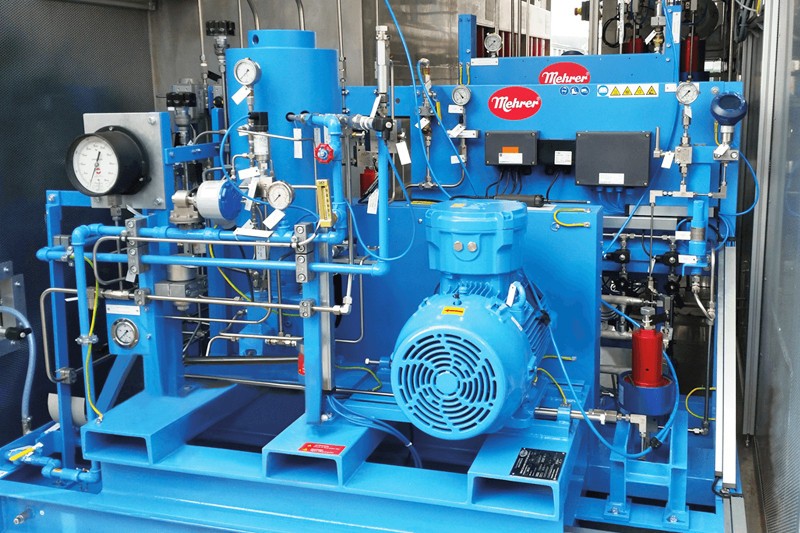
| Series | MRE 300 |
| Description | single-stage |
| Suction pressure | 30-100 bar(a) |
| Final pressure | 935 bar(a) |
| Volume flow | 29 cubic metres per hour |
| Gas state | dry |
| Cooling | water-cooled |